






AI ESTATE PLANNING
Agentic Estate Planning: The Definitive Guide for Advisors
A practical framework for what “agentic” means in estate planning, where it helps, where it’s risky, and how advisors can evaluate any vendor claim.


Agentic Estate Planning
Agentic estate planning is the use of AI systems that can initiate and carry out defined estate-planning workflows, such as analyzing documents, monitoring for changes, and surfacing issues for review, so advisors can respond faster and more consistently.
At Vanilla, that means proactive, supervised AI that does real planning work in the background without outsourcing judgment or responsibility: AI prepares the work, advisors make the final call.
Defining “agentic” in estate planning (and what it isn’t)
Estate planning technology, much like estate planning itself, has historically been reactive: it waits for an advisor to know which question to ask, which document to pull, which fact pattern to look for. Agentic technology inverts that. Instead of waiting to be prompted, it can review information on defined cadences or triggers and initiate bounded work on its own, within defined limits. In this context, ‘workflows’ are bounded tasks with clear stop points and review requirements.
Here is what that looks like in practice. A signal appears, say, a newly uploaded deed showing a rental property titled outside any trust. The system prepares an analysis: what the discrepancy is, why it matters, what probate exposure it may create. That analysis goes to the advisor for review. The advisor decides what happens next, whether that is a client conversation, a referral to the client’s estate planning attorney, or no action at all.
Agentic does not mean autonomous. The system does not decide, act on a client’s behalf, or communicate with a client directly. AI prepares the work. Advisors make the final call.
Agentic AI vs. AI copilots vs. rules-based automation
AI and agentic terms get used loosely, and the differences matter more in estate planning than in most software categories, because the stakes involve fiduciary duty, legal consequence, and family dynamics.
| Rules-based automation (deterministic) | AI copilot | Agentic AI (supervised agent) | |
|---|---|---|---|
| Trigger | Fixed condition (if X, then Y) | User prompt | Proactive monitoring on defined cadences or triggers |
| Output | Executes a predefined step | Answers or drafts on request | Prepares analysis and suggested next steps for advisor review |
| Review | None required | Reviewed as part of the conversation | Advisor reviews and approves before anything is client-facing |
| Best-fit tasks | Repetitive, fixed-logic steps (e.g., calculations) | On-demand drafting or Q&A | Ongoing monitoring across a full book |
| Risk profile | Low, but inflexible | Moderate, depends on prompt quality | Requires guardrails and audit trail to manage safely |
Rules-based automation is deterministic: given the same inputs, it produces the same output every time. That means a rules-based system does exactly what it is configured to do and nothing more. A copilot is responsive: capable, but it still needs to be asked. An agent works proactively across an advisor’s book without waiting for a prompt, and prepares its findings for review rather than acting on them unsupervised.
These aren’t competing approaches. In practice, agentic AI and deterministic systems work together. The agent handles orchestration and judgment, while deterministic engines handle anything that needs an exact, repeatable answer. For example, an agent might flag that a client’s estate is approaching a tax threshold, then hand that finding to a deterministic system to calculate the precise figure, rather than estimating it directly.
Advisors have already generated more than 50,000 AI estate summaries using Vanilla’s copilot tools, real usage at the level automation and copilots operate today. Supervised agentic workflows are the next evolution, extending that foundation from responding on request to working proactively under the same review standard.Agentic workflows build on that same foundation, extending it from responding on request to working proactively, under the same review standard.
Chatbot is not a copilot, and a copilot is not an agent. Each term describes a different amount of initiative the system takes, and advisors evaluating vendors should expect precision about which one a product actually is.

The maturity model
Not all “agentic” claims describe the same thing. A useful way to evaluate any vendor’s claim is against a four-level maturity model:
- Rules-based (deterministic) — the system executes fixed logic with no judgment involved.
- Copilot — the system responds to a prompt with analysis, drafting, or answers.
- Supervised agent — the system initiates work on its own, within guardrails, and surfaces it for advisor review and approval before anything reaches a client.
- Autonomous — the system acts and communicates independently, without a human reviewing the output first.
Level three, the supervised agent, is the responsible frontier for estate planning technology today. It captures the real advantage of agentic behavior, working proactively rather than waiting to be asked, without removing the advisor’s judgment from anything a client sees. This isn’t just an intentional design approach but a reflection of advisor preferences. A 2026 survey of financial advisors found that most want AI handling administrative work, not client-facing judgment: 59% want it to automate scheduling and meeting prep, while 68% say long-term client trust still requires a human touch.
Level four introduces risk that an advisory firm’s fiduciary and legal obligations are not currently built to absorb, regardless of how capable the underlying model is. Additionally, reaching level four isn’t a default trajectory every platform climbs toward. Any movement into autonomous action would happen only for specific tasks, and only with explicit approval from the advisor or firm, not as an automatic evolution of the technology.
What this changes for the advisor’s day-to-day
Under a reactive model, an advisor’s review cycle depends on the advisor’s own bandwidth. A client’s life change, a divorce, a move, a new grandchild, surfaces only if the client mentions it or the advisor happens to ask at the next scheduled review, which might be a year away.
Under a supervised-agent model, the advisor’s day starts differently: not with a blank task list, but with a prioritized review queue. The system has already reviewed what changed, prepared an analysis of what it means, and organized it by relevance. The advisor’s job shifts from searching for what needs attention to reviewing what has already been found and deciding what to do about it.
This changes capacity and consistency, not the advisor’s role. The advisor is still the one who decides, who has the client conversation, and who determines what the client actually needs. What changes is how much of a book can receive that same level of attention, and how quickly a relevant change gets caught rather than surfacing months after it mattered.
What agentic estate planning workflows look like in practice
These workflows describe supervised-agent patterns the category is moving toward; availability and timelines vary by platform.
Document ingestion and discrepancy detection
What it will do: Review uploaded client documents on a defined cadence and flag potential discrepancies for review, such as an asset that appears titled outside a trust or an outdated beneficiary designation.
Outputs the advisor receives: A flagged item for review, a plain-language explanation of why it may matter, and supporting excerpts/citations from the source document.
Where review happens: The advisor reviews every flagged item before deciding whether to raise it with the client or escalate to the client’s attorney.
Micro-example: A newly uploaded deed shows a rental property outside any trust. The system flags the item and prepares a brief explanation of the probate exposure it may create, with supporting excerpts for the advisor to review.
Collaborative profile building and estate-diagram readiness
What it will do: Assemble and organize draft client profile information as documents and data arrive, preparing inputs toward a complete estate diagram.
Outputs the advisor receives: A draft profile that is progressively populated and organized, including a structured balance sheet of assets and liabilities, with gaps and inconsistencies clearly marked for review.
Where review happens: The advisor confirms accuracy and completeness before the profile is treated as final.
Micro-example: As a client’s documents are completed, the system organizes family structure, assets and liabilities, and fiduciary roles into a single profile, flagging any information still missing.
Whole-estate review and opportunity surfacing
What it will do: Review a client’s full estate picture and surface potential planning opportunities and questions for the advisor’s consideration.
Outputs the advisor receives: A prioritized list of potential opportunities, with the reasoning and supporting inputs behind each one.
Where review happens: The advisor evaluates each surfaced opportunity and determines whether and how to raise it with the client.
Micro-example: The system identifies that three children are set to receive trust assets outright at age thirty-five and surfaces this as a planning conversation for the advisor to consider raising.
Scenario exploration support (later-phase, as the category matures)
What it will do: Help advisors explore the potential effects of planning changes across a client’s estate, based on advisor-provided assumptions.
Outputs the advisor receives: Comparative scenario outputs for the advisor to review and discuss.
Where review happens: The advisor interprets results and determines their relevance before any client discussion.
Get Updates on VAI
The agentic workflows described above are coming to VAI.
Be the first to know when they launch.

Where full autonomy is dangerous
Fiduciary responsibility does not transfer to software. An advisor who relies on an autonomous system’s output without independent judgment has not been relieved of accountability, only exposed to a new source of error they did not create and cannot fully audit.
Legal advice and determination require attorney involvement that a technology platform cannot substitute for, regardless of its sophistication. Any system that implies otherwise is creating risk for the advisor and the client, not removing it.
Family dynamics require judgment that no model has: knowing when a client is not ready to hear something, how to sequence a difficult conversation across siblings with competing interests, or when a technically correct recommendation is the wrong thing to raise at a given moment. An autonomous system that acts on a family’s behalf without that judgment risks damaging the relationship it was meant to strengthen.
Consider a system that autonomously sends a client-facing communication flagging a family wealth transfer discrepancy without advisor review. The communication could be factually accurate and still land badly, discovered by the wrong sibling first, phrased without the sensitivity the situation required, sent at a moment the advisor would have chosen differently. Supervision exists precisely to catch what the model cannot know to consider.
There’s a narrower risk too: AI generating a financial calculation directly, rather than identifying what needs attention and routing the calculation to a system built to get it exactly right. Estate and tax calculations have precise, verifiable answers, and a model estimating one on its own can sound confident while still being wrong. The safer approach keeps a firm boundary between the two jobs: AI identifies what needs to be calculated and why it matters, then hands the calculation itself to a deterministic, rules-based system rather than producing the number on its own.
None of this means the technology falls short. It means certain things were never the technology’s job, and others call for a different kind of system entirely. Agentic AI does not carry accountability, exercise legal judgment, or read what a family needs in a difficult moment. Those stay with the advisor and the client’s attorney. Calculations, scenario projections, and other precise outputs stay with deterministic systems built for exactly that. What agentic AI changes is how consistently that expertise reaches every client in a book, not just the ones with time on the calendar.
This content is for informational purposes only and is not legal advice.
How to evaluate any “agentic” vendor: a 7-question checklist
“Agentic” is on the same trajectory as plenty of terms before it, including ones we’ve used ourselves. Labels wear out. The questions below are how you get past any label to what’s actually built. In every case, the standard is specificity: if a vendor can’t answer with clear boundaries and documentation, treat it as a red flag.
-
- What autonomy level is this, specifically? Look for a direct mapping to the maturity model (rules-based, copilot, supervised agent, autonomous) named plainly, not described only in benefits language.
- Who is responsible when it acts, and what, specifically, counts as an ‘action’? The right answer names who bears accountability (advisor, firm, vendor) and defines what the system can initiate without human approval.
- What guardrails and stop points exist? Expect explicit limits on what the system can do on its own, plus clear stop points where review and approval are required—not general assurances that the system is “safe.”
- Is there an audit trail? The vendor should be able to show that actions and review decisions are logged and retrievable, with enough detail to understand what happened, when, and why.
- How is the system’s output validated, and what happens when it’s wrong? Ask for a named validation process and the expertise behind it, plus a concrete rollback or escalation path when outputs are incorrect or incomplete.
- What defensible domain expertise or intellectual property backs the system’s judgment? Look for demonstrated, specific depth (who built it, what expertise shaped it, and how that judgment is operationalized) rather than generic claims of expertise.
- Is client data used to train the underlying model? A credible answer is explicit: the vendor can state whether client data is used for training, describe what information is sent to any language model (and how sensitive information is handled), and provide written documentation on isolation, retention, and deletion policies.
Red flag: any vendor that cannot answer a question on this list with specifics, or that answers by restating what “agentic” generally means rather than what their system specifically does.
How Vanilla approaches supervised agentic workflows
Vanilla is building VAI around one principle: AI prepares the work, and advisors make the final call. Every workflow VAI initiates is designed to surface analysis and options for advisor review, not to act on a client’s behalf or communicate with a client directly. That review step, and the ability to trace what the system found and why, sits at the center of how the system is built.
Why we’re approaching it this way
- Built for the domain, not adapted to it: VAI is grounded in real-world planning judgment from a team with 190+ years of combined trust and estate experience, and designed around estate-planning concepts, documents, and workflows rather than generic AI applied after the fact.
- Deterministic execution for precise outputs: VAI is designed to surface what needs attention, then rely on deterministic logic for work that requires exact, verifiable answers (for example, calculations and structured outputs), rather than asking a model to “guess” a number.
- Designed for enterprise trust: Vanilla undergoes an annual SOC 2 Type II audit, with clean reports since 2022, and maintains security controls appropriate for sensitive financial and estate planning data.
- Privacy and data handling: VAI uses commercial, enterprise-grade models via secure APIs. No customer data is used for model training or improvement. VAI is built with controls to protect sensitive client information, and firms can enable or disable VAI at the account level.
- Governance, monitoring, and evaluation: VAI is built with layered controls and ongoing evaluation, including monitoring for anomalies and misuse, activity logging for supervision, safeguards across the AI model supply chain, and continuous testing against a representative set of estate scenarios informed by Vanilla’s experience across 30,000+ estates.

What’s next for agentic estate planning
Governance and auditability will become the real differentiators in this category, not the word “agentic” itself. As more platforms adopt the term, the meaningful question will keep shifting from whether a system is agentic to how its autonomy is bounded, validated, and made accountable.
Expect marketing noise to increase before it clarifies. Advisors evaluating any platform’s claims can use the seven-question checklist above as a standing reference, independent of which vendor is making the claim.
References:
Anthropic (agents)
NIST AI Risk Management Framework
Featured Resources

What to Look for in AI Estate Planning Software: A Financial Advisor’s Checklist
As demand for estate planning increases, adoption of AI estate planning software is accelerating. Last year, Kitces Research projected that by 2026, nearly half of...

Trust, Legal, & Security
At Vanilla, security, trust, and data protection are vital to our business. Vanilla uses best practices and industry standards designed to keep data safe, which...
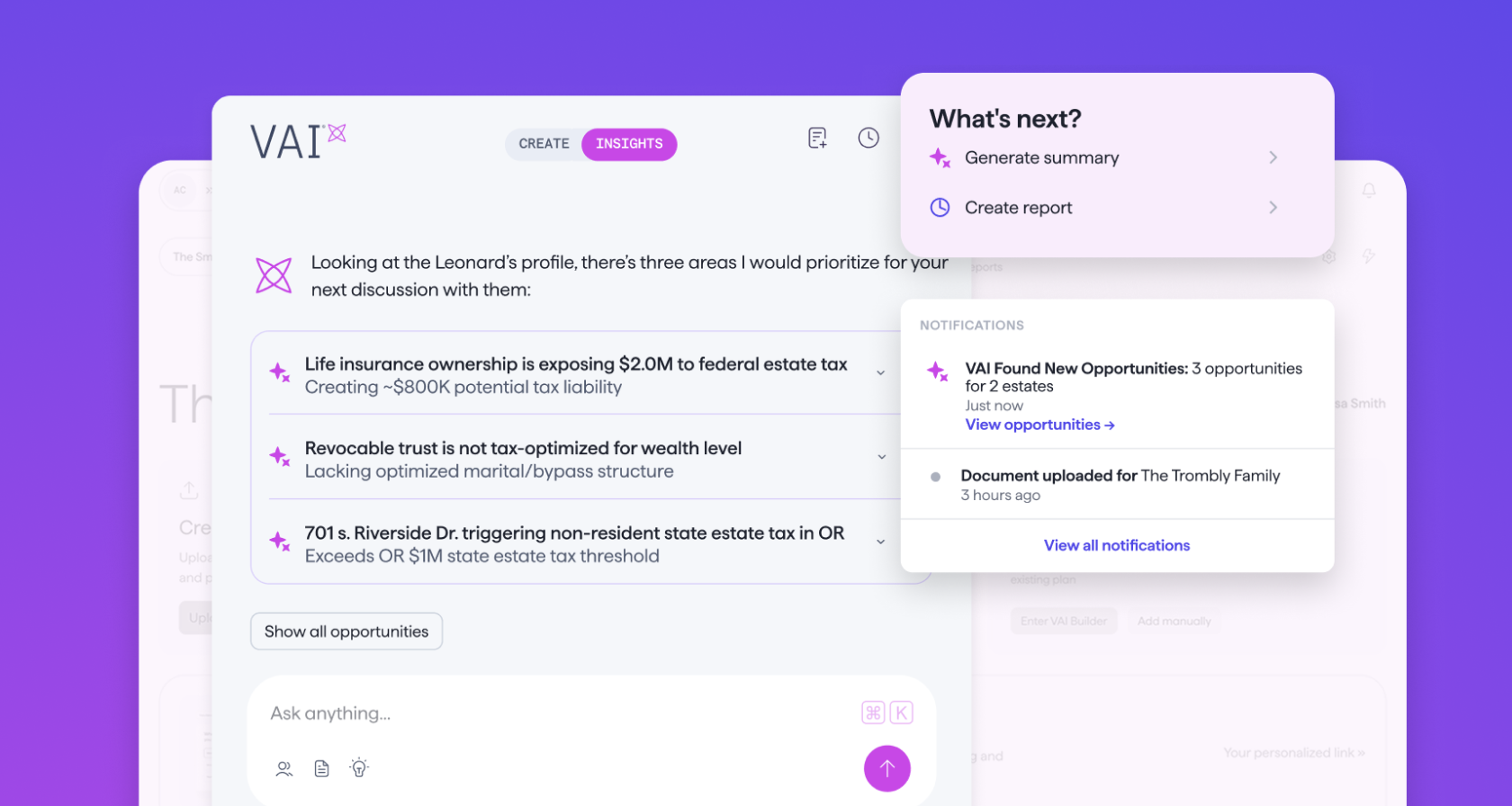
Meet VAI, Vanilla AI for estate planning
See how Vanilla AI helps financial advisors surface estate planning insights faster and support more efficient client planning workflows.
Stay close to the launch.
General availability begins later this year. Be the first to hear as we approach release.